
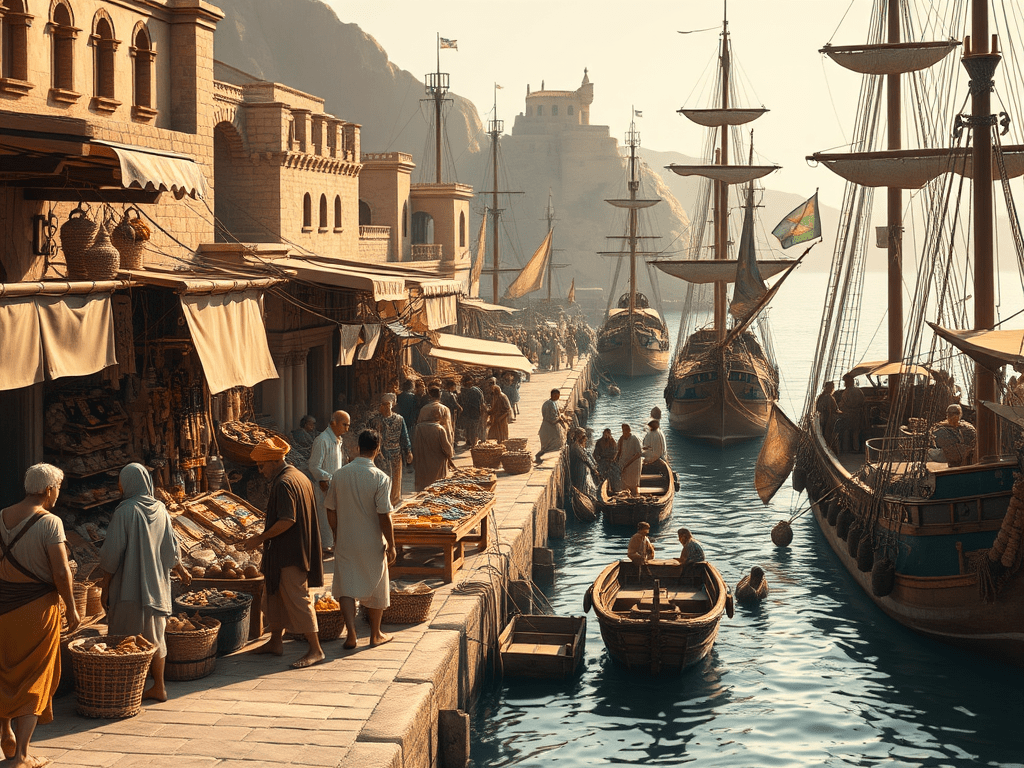
There was a time when the word commerce meant something entirely different from what it does today.
In ancient civilizations — from the Phoenicians to the Silk Road merchants — commerce was not about selling. It was about connecting.
Merchants were not transaction-makers. They were peace-makers.
They travelled between cities, languages, and belief systems, carrying goods, ideas, and stories.
They took risks, built trust, and created prosperity through exchange.
Commerce, in that sense, was an act of civilization.
It made societies depend on each other rather than destroy each other.
It taught people that cooperation could be more powerful than conquest.
The merchant was respected not for what he sold, but for what he enabled: stability, knowledge, and trust between strangers.
The Industrial Revolution and the Birth of the Salesman
Then came the Industrial Revolution.
Production accelerated. Scale became the new virtue.
Factories replaced workshops, and abundance replaced scarcity. But something else changed too — something invisible.
The merchant slowly disappeared, and a new figure emerged: the salesman.
The merchant was the bridge between people.
The salesman became the bridge between the product and the quota.
Where the merchant created value through relationships, the salesman was measured by volume.
Where the merchant’s role was to cultivate trust, the salesman’s role was to close deals.
It was not necessarily wrong — it was the logic of industrialization.
But it marked a profound shift in mindset: from mutual value creation to performance extraction.
Commerce became an engine of growth, but it lost part of its soul.
The Modern Trap: When Customers Become Cost Centers
In today’s world, this industrial mindset still shapes how we manage customers.
We celebrate acquisition, but rarely measure alignment.
We measure revenue, but often ignore profitability per customer.
The result is predictable:
many companies end up serving customers who drain their teams, margins, and motivation.
At Ezo, we call this the Service Intensity Index — the idea that not all revenue is created equal.
Some customers consume far more energy than they return in value.
And sometimes, the most “difficult” ones are not the biggest, but the least aligned.
Here’s the paradox:
The decision to lose a difficult customer is often the most profitable act of commerce.
It takes courage to accept that not every client deserves to be kept.
But that courage is what restores balance — between energy and reward, effort and meaning.
The New Merchant Mindset
If the Industrial Revolution created the salesman, perhaps the digital and human revolutions of our time can bring back the merchant.
A new generation of leaders, founders, and commercial teams are rediscovering what commerce was always meant to be:
an act of connection, not domination.
They understand that the real game is not selling more, but selling better.
Not maximizing short-term gain, but maximizing mutual value over time.
They look at each customer relationship not as a transaction, but as an ecosystem:
a space where both parties learn, grow, and evolve together.
This mindset is not nostalgic. It is deeply modern.
Because in a world of complexity, trust has become the ultimate differentiator.
Technology can automate transactions.
AI can predict behaviors.
But only human intention can sustain value over time.
Choosing Customers Is a Strategic Act
Every company says they want profitable growth.
Few are ready to do what it takes to get there:
choose their customers.
Choosing means saying no.
It means focusing energy where value is co-created, not consumed.
It means refusing the illusion that all revenue is good revenue.
At Ezo, we often say: Choose your customers, choose your future.
Because in the end, every decision about who you serve shapes who you become.
When you accept to lose a customer who doesn’t fit, you don’t lose revenue.
You gain clarity, energy, and space for the right ones to find you.
Full Circle
Commerce started as a human act.
It became a mechanical system.
Now it has the chance to become human again.
Maybe the next era of commerce won’t be about more products, faster transactions, or cheaper prices.
Maybe it will be about rediscovering what the first merchants knew thousands of years ago:
That real prosperity comes not from selling,
but from creating peace through value shared.
 Learning for Performance